Home / Engineering services
Connected product engineering, from requirement to production.
Schematic design, multi-layer PCB layout, embedded firmware, enclosure and thermal design, device infrastructure and a manufacturing handover your fabricator can build from without calling us. Delivered by the team that has been putting its own hardware on Indian walls since 2018.
Designing electronics in India, from Palghar
Disciplines delivered as a single programme
Commercial stages, each authorised before the next
%
Design ownership transferred to the client
The position
An electronics department you do not have to build.
A connected product needs a circuit designer, a layout engineer, a firmware developer, a mechanical designer and somebody who understands provisioning and field telemetry. Hiring five specialists for one product is not a proportionate decision, and hiring one generalist to cover five disciplines produces a board that works on a bench and fails in a wall.
The hiring problem
Five disciplines, one product. The salaries are permanent and the requirement is not. Most companies solve this by asking one engineer to cover all five, and inherit the result on the revision after next.
The tooling problem
Layout software, a licensed component library, a reflow process and a bench capable of finding a fault at 400 megahertz. Capital that sits idle between products and depreciates while it waits.
The continuity problem
A component goes end-of-life four years after launch. A company that designed the product changes the design. A company that outsourced it and kept no source renegotiates, waits, or stops selling.
We take the work, and you keep the design. The distinction runs through every clause of how we are engaged, and it is set out in full further down this page.
Capability
Nine disciplines, delivered as one programme.
Each is available on its own. They are listed in the order a product actually moves through them, because the sequence is where the cost sits — a decision taken at discipline two is inexpensive, and the same decision taken at discipline seven is a re-spin.
01 · Requirement capture and product specification
Function, operating environment, regulatory exposure, target unit cost, intended volume and the interfaces the product must respect, written down and signed by both sides before anything is drawn. It is deliberately the cheapest stage, because it is the stage at which a product is correctly stopped or correctly re-scoped.
You receive: a written specification signed by both parties; the operating envelope covering thermal, ingress, supply and EMC exposure; a target landed cost at stated volume; and the interface and protocol constraints fixed in writing.
02 · Schematic design and component selection
Topology chosen for this product and this cost rather than inherited from a reference design drawn for another market. Parts selected against Indian availability, Indian lead times and Indian import reality, with a second source identified for anything on the critical path.
You receive: a hierarchical schematic, reviewed and annotated; a bill of materials with manufacturer part numbers; a second source named for every critical line item; and the power budget and supply tree.
03 · Multi-layer PCB layout
Placement, stack-up, impedance control, return paths and thermal relief, routed against the fabricator’s actual capability rather than a generic rule set. Layout is where a schematic that is correct on paper becomes a product that passes or fails EMC.
You receive: a stack-up agreed with the fabricator before routing; controlled impedance on all high-speed nets; thermal relief and copper balance reviewed; and a design rule check clean against the chosen fab.
04 · Embedded firmware development
Written against this board and this revision, with the source handed over and the build reproducible on your own machine. Firmware you cannot rebuild is a dependency on a supplier, not an asset on a balance sheet.
You receive: source, build scripts and documented toolchain versions; a field-update path designed in rather than added afterwards; specified fault behaviour for loss of power and loss of network; and a reproducible build verified on a clean machine.
05 · Board bring-up and design validation
First articles powered, instrumented and characterised against the specification signed at discipline one. Findings are written up whether they are convenient or not, and the report is yours whatever you decide to do about it.
You receive: a bring-up log per rail and per subsystem; measured performance against the written specification; thermal characterisation at the stated operating envelope; and a defect list with severity and recommended action.
06 · Enclosure, thermal and mechanical design
A sealed box on a wall in Palghar in May is a thermal problem before it is an industrial design problem. Mechanical work runs alongside the electronics rather than after it, because an enclosure designed around a finished board is how a product gains six millimetres it cannot afford.
You receive: an enclosure drawn against the board, concurrently; a specified thermal path and ingress rating; tooling-ready 3D data and 2D drawings; and mounting, serviceability and cable entry resolved.
07 · Device provisioning and telemetry infrastructure
Identity, secure onboarding, update delivery and field telemetry, deployable on infrastructure you control inside your own premises or hosted by us, with a documented route between the two. A connected product without a provisioning story is a prototype with a radio.
You receive: per-device identity and secure onboarding; update delivery with rollback; a telemetry schema defined with your operations team; and deployment on your premises or hosted, reversible either way.
08 · DFM review and production handover
The package a fabricator and an assembler can build from without calling us, reviewed against the specific process that will build it. Handover is a deliverable with a checklist, not an email with a folder attached.
You receive: process-reviewed fabrication and assembly data; pick and place, paste layers and panelisation; a test strategy with end-of-line criteria; and a handover checklist signed off item by item.
09 · OEM manufacture and design continuity
Continued build of designs already in production, and engineering changes on request when a component goes end-of-life or a specification moves. This is the discipline that keeps a product alive in year five, and it is the one most companies discover they need only once they need it.
You receive: continued manufacture of designs in production; end-of-life component substitution and re-qualification; engineering change on request, quoted per change; and revision control maintained across the life of the product.
How work is structured
Quoted by stage. Authorised by stage.
Nobody signs for a whole product on day one. Each stage is quoted, delivered and signed off before the next is authorised, which means the point at which you can stop is always the point you have just paid for.
We establish what the product has to do, where it has to survive, what it may cost and what it must not become. The output is a written specification both sides sign, and it governs everything after it. This stage exists to make the expensive decisions early and cheaply. It is also the stage at which we will tell you if the product should not be built, or should be built differently, and we would rather have that conversation here than at bring-up.
You leave with: a signed product specification; the operating envelope and regulatory exposure; an indicative bill-of-materials cost at volume; and a staged programme and quotation.
Schematic, layout, firmware, mechanical and validation, run as one programme against the signed specification. Progress is reported against the specification rather than against effort. Changes raised during this stage are quoted before they are made, and a change that moves the specification moves the specification document too, so there is never a question afterwards about what was agreed.
You leave with: schematic and layout source; firmware source and a reproducible build; a bring-up and validation report; and tooling-ready mechanical data.
Identity, provisioning, update delivery and telemetry, deployed where you want them to live. If that is your own premises, they run on your premises. If that is hosted, it is hosted, and moving later is a documented procedure rather than a rebuild. This stage is optional — a product that is not connected goes straight to transfer, and a product that becomes connected in year two can come back for it.
You leave with: a provisioning and identity scheme; an update and rollback path; a telemetry schema and retention position; and a deployment runbook for your team.
The complete package handed over, checked item by item against a list, with the intellectual position stated in writing. Manufacture with us afterwards if you want to. Do not, if you do not. This is the stage that decides whether you own a product or rent one, and we treat it as a deliverable with a checklist, because a handover that is merely intended is a handover that does not happen.
You leave with: full source — schematic, layout and firmware; fabrication, assembly and test data; a bill of materials with second sources; and a signed handover certificate.
The design is yours, and it leaves with you.
On completion of a stage you receive the source for that stage — schematic, layout, firmware, mechanical data and the bill of materials with manufacturer part numbers. Not a rendered PDF. Not a locked file. The working source, and the instructions to rebuild it.
You can take it to another manufacturer the next day. We would rather earn the build than hold the drawings hostage to get it, and a client who is free to leave is a better reference than one who cannot.
The package
What is in the folder at the end.
Every item below is a deliverable, not an intention. If one of them is not applicable to your product, it is removed from the quotation rather than quietly omitted from the handover.
Schematic source
Hierarchical, annotated, in the working format — not an export.
Layout source
With the stack-up, impedance targets and design rules as applied.
Firmware source
Plus build scripts, toolchain versions and a verified clean build.
Bill of materials
Manufacturer part numbers, with a second source on every critical line.
Fabrication data
Gerbers, drill, netlist and panelisation, reviewed against the chosen fab.
Assembly data
Pick and place, paste layers, assembly drawing and process notes.
Mechanical data
Tooling-ready 3D, 2D drawings, material and finish specification.
Test strategy
End-of-line criteria, fixtures where required, pass and fail limits.
Manufacture
Designs that outlived the brand that carried them.
Our own consumer brand wound down so the company could build the platform that designs hardware. The designs did not wind down with it. Contractors who could source from anywhere are still building them, and plates engineered and manufactured here are sold across India under other companies’ brands.
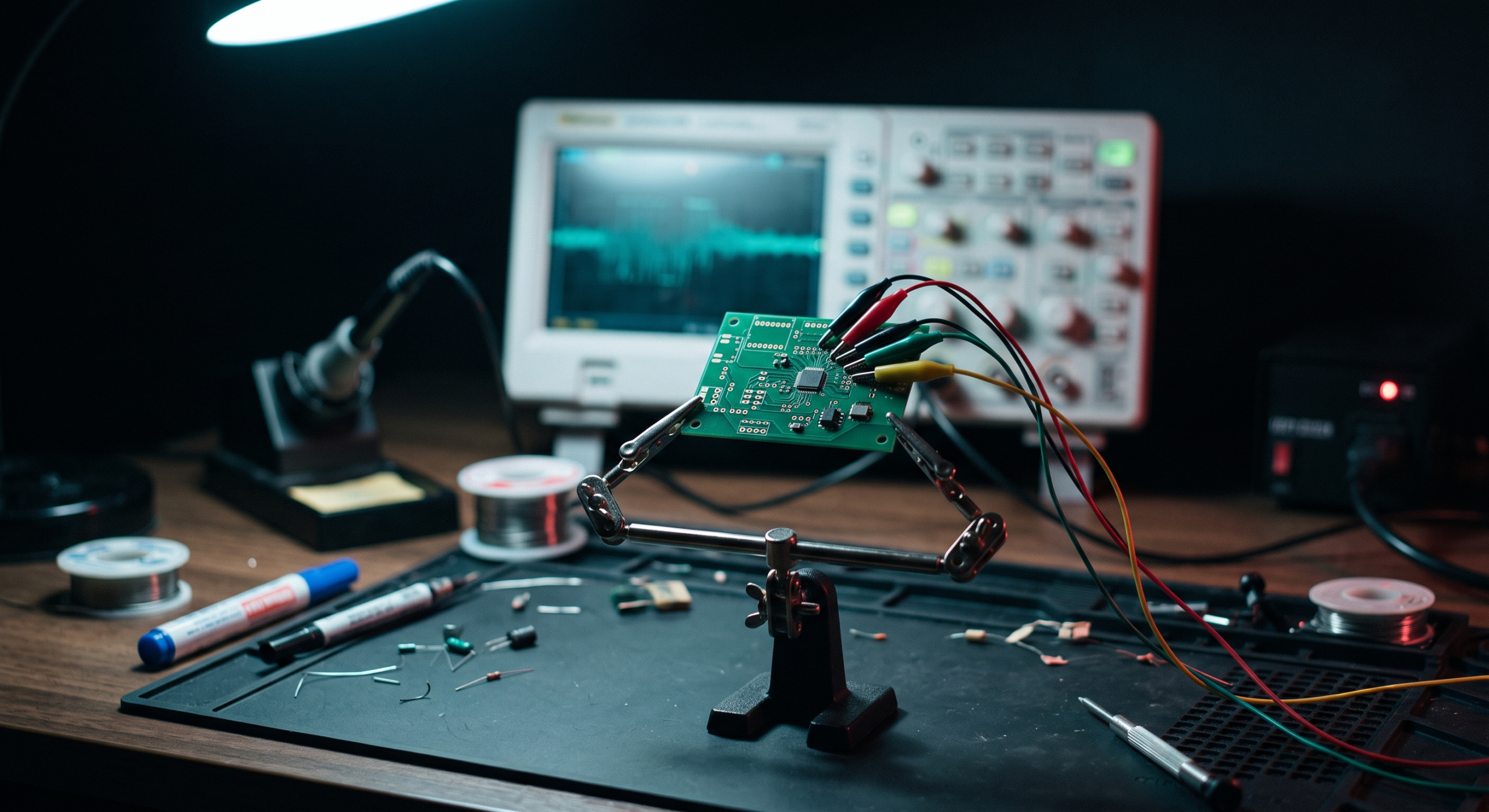
That is the honest measure of whether an engineering decision was sound. A brand can close for a dozen reasons, most of them unflattering. Designs still being built by buyers who are free to go elsewhere is a different fact, and it is the one we would point a prospective client at.
Boundaries
Work we do not take on.
Stating this plainly costs us a small number of enquiries and saves everybody the three meetings it would otherwise take to reach the same place.
We do not certify the products we design
Certification is issued by an accredited body, not by a design house. We design toward the standards your product has to meet, we prepare the documentation the test house asks for, and we attend testing and resolve findings. The certificate is issued by the laboratory, and any engineering company that implies otherwise is worth a second question.
We do not design flight-critical or medical devices
Anything carrying people, and anything a clinician makes a decision from, sits inside certification regimes with design-assurance requirements we do not hold. We will say so at the first conversation rather than the fourth, and we would rather lose the enquiry than take it on and discover the gap at validation.
We do not design weapons
No qualification and no conditions attached to that sentence.
Questions
What clients ask before the first meeting.
What happens in a requirement capture stage?
Function, operating environment, regulatory exposure, target unit cost, intended volume and the interfaces the product must respect are established and written down. It is delivered as a specification both sides sign. It is deliberately the lowest-cost stage, because it is the stage at which a product is correctly stopped or correctly re-scoped.
Will you work with our existing schematic or board?
Yes, including designs the original engineer is no longer available to explain. The first step is a design review that establishes what the circuit is doing and why, because changing a board nobody currently understands is how a revision becomes a redesign.
Which files do you hand over?
Schematic and layout source, fabrication and assembly data, bill of materials with manufacturer part numbers, pick and place data, and firmware source with its build instructions. Everything a fabricator needs, and everything your own engineers need to maintain the product without us.
Can you handle a component going end-of-life on an old product?
Yes, and it is one of the more common reasons a company contacts us. The work is a substitution study, a layout change if the footprint moves, a firmware change if the interface moves, and re-qualification against the original specification. It is quoted as an engineering change rather than a new product.
Do we have to manufacture with you afterwards?
No. The handover package is complete enough to take to any competent fabricator and assembler. We manufacture for clients who want us to, and the ones who take the package elsewhere remain references we are happy to give.
Where does device data live?
Wherever you decide. Device infrastructure can be deployed inside your own premises on hardware you own, or hosted by us. Moving from one to the other is a documented procedure rather than a rebuild, and the decision is not locked at the start of a project.
Next step
Bring the requirement, the drawing, or the board that stopped working.
A first conversation costs nothing and usually establishes within half an hour whether this is a specification problem, an engineering problem or a manufacturing problem. Those are three different quotations, and knowing which one you have is worth having before you ask anybody for a price.
Chandrahas Technologies Private Limited
CIN U72900MH2017PTC300644
Registered address to be inserted here, byte-exact from the Certificate of Incorporation.